







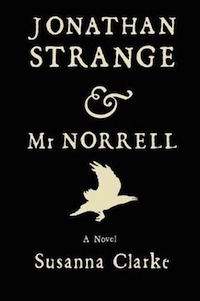
Hello, everyone! Welcome back to the reread of Susanna Clarke’s Jonathan Strange & Mr Norrell. You can find the full schedule for the reread in the introduction post; catch up on past posts at the reread index; or check out Tor.com’s other posts about this book through its tag.
Please note that these reread posts will contain spoilers for all of JS&MN plus The Ladies of Grace Adieu. There’s accordingly no need to warn for spoilers in the comments—and comments are highly encouraged.
This week, the reread covers the opening of Volume III with chapters 45 through 49, in which Jonathan Strange and Lady Pole react in their own ways to the end of Volume II.
Scheduling note: because of Christmas and New Year’s, the reread will return on January 9, 2015. However, I’m including in this post recommendations for some JS&MN fanworks, in case that gives you something extra to do over the break.
Chapter 45: Prologue to The History and Practice of English Magic
(This chapter has no date heading; the book is finished in early June 1816 and published shortly thereafter.)
What Happens
This chapter reproduces in full the prologue to the only book Strange ever published. It describes how in 1110, the Raven King led the Fairy Host in conquering Northern England as “a just recompense for the failure of the Norman kings to avenge the murders of his family.”
At the age of fourteen he had already created the system of magic that we employ today. Or rather that we would employ if we could; most of what he knew we have forgotten. His was a perfect blending of fairy magic and human organization — their powers were wedded to his own terrifying purposefulness. There is no reason that we know of to explain why one stolen Christian child should suddenly emerge the greatest magician of any age. Other children, both before and since, have been held captive in the borderlands of Faerie, but none other ever profited from the experience in the way he did. By comparison with his achievements all our efforts seem trivial, insignificant.
It is the contention of Mr Norrell of Hanover-square that everything belonging to John Uskglass must be shaken out of modern magic, as one would shake moths and dust out of an old coat. What does he imagine he will have left? If you get rid of John Uskglass you will be left holding the empty air.
Commentary
We open Volume III, which is titled “John Uskglass,” with Strange’s history of him. This serves two purposes: first, it lays out squarely and neatly all the context we’ve been building up about the Raven King (which I prefer to call him, since he used it for longer than John Uskglass (his father’s name), and it feels more fitting).
Second, it allows us to again pull back sharply from Jonathan Strange after a time of great emotion. After Waterloo, it was two chapters before we returned to his POV; here, after Arabella’s apparent death, it is three. The non-narrative nature of this chapter allows an even greater distancing. From what I recall of the Italy section, this pullback is necessary to allow the book to build to that intensity; but I can see that it might also be frustrating to people, especially on a first read.
Minor comments:
The footnotes in this chapter are Strange’s and not our narrator’s; one of the footnotes here says “When he was a child in Faerie the Sidhe had called him a word in their own language which, we are told, meant ‘Starling,’” and in chapter 47, the narrator footnotes a name spoken by the gentleman as “Presumably the Raven King’s original Sidhe name, which Jonathan Strange thought meant ‘Starling’.”
The Raven King is “pale and handsome and solemn-faced,” with long, straight, dark hair.
It is perfectly reasonable for the Raven King to have been also called “the King in the North,” but I’m glad that only appears in this one footnote, because associating JS&MN with A Song of Ice and Fire caused such cognitive dissonance that my brain locked up for a moment.
Chapter 46: “The sky spoke to me…”
January 1816
What Happens
Childermass is writing letters in Hanover-square and begins to feel that magic is being done. Norrell is not in the house, so he does a spell to find its source. He sees magic outside and perceives a doubled landscape, London and Faerie, and feels that the sky is asking him a question. He nearly faints, loses the magic, and then sees a woman, who appears to have unnatural strength, attempt to shoot a returning Mr Norrell. He grabs the pistol and is wounded.
During Childermass’s recovery, Mr Norrell demands to know why Childermass was performing magic—he had forgotten that he had taught Childermass that spell himself, years ago. Childermass tells Norrell about the sky speaking to him, a view of magic that Norrell takes as a betrayal, but Childermass reassures him: “Mr Norrell, calm yourself. I have no intention of taking up any new employment. You are the last master I shall ever have.” Mr Norrell admits that the woman was Lady Pole, who blames Norrell for Arabella Strange’s death and who Sir Walter has agreed to isolate in the country. Childermass seems to suspect that Norrell was lying about something related to Lady Pole and/or Arabella’s death.
Commentary
We continue at an emotional distance from the action, being in Childermass’s POV instead of Lady Pole’s. Again, in terms of the tone of the book and being at the start of a volume, not the middle or end, this makes sense to me. But it’s a little frustrating too, because I have two questions about the logistics that can’t be answered from this perspective.
First: Lady Pole’s apparent supernatural abilities.
[Childermass] saw the woman shrug herself free of Mr Marston’s grasp with what seemed like remarkable ease. She pushed him to the ground with such force that he did not get up again. She put one small, gloved hand to Davey’s chest and Davey was flung several yards backwards. Mr Norrell’s footman — the one who had opened the carriage door — tried to knock her down, but his blow had not the least effect upon her. She put her hand upon his face — it looked like the lightest touch in the world — he crumpled to the ground.
Something about Lady Pole’s state of being partly trapped in Faerie must account for this, because nothing else about her can—she’s very energetic in her unenchanted state but that doesn’t make her Jean Grey. But we’ve never had a hint of it before and the logic of it escapes me.
Second: the keys to the pistol had been in Stephen’s keeping, and Norrell says it is a mystery how she got them. We’ve had little indication that Stephen’s become careless or his work has suffered because of his magically-induced depression. Yet Stephen’s POV next chapter doesn’t feel like someone who was part of a conspiracy to commit murder. And the only other thing I can think of, that the gentleman interfered, doesn’t feel right either; for one thing, I’d expect him to complain about the plan’s failure, next time Stephen sees him. I’m inclined to go with carelessness on Stephen’s part, but it vexes me that I have to guess at it.
On another note: Childermass is apparently this close: >< to restoring English magic: “The sky spoke to him again. This time he thought it was a question. Great consequences hung upon his answer.” Again, he’s linked to Mr Segundus, this time implicitly: they both can sense magic around them and are overcome by its effects, but Childermass is a practicing magician and Mr Segundus is not, yet.
Finally: Norrell is a terrible liar. (I wonder what he thought he might have done to prevent Arabella’s death, though?)
Chapter 47: “A black lad and a blue fella — that ought to mean summat.”
Late January 1816
What Happens
Stephen brings Lady Pole to Starecross, where Mr Segundus has taken up madhouse-keeping on gentle, comforting principles. Mr Segundus sees that both Stephen and Lady Pole are surrounded by magic, with red-and-white roses at their mouths; but Stephen has no reason to trust him, and much reason to distrust English magicians, and pretends not understand when Mr Segundus asks him about it.
On his way back to London, a coachman strikes at Stephen with his whip because Steven is black, which causes his horse to fall and fatally injure herself. Stephen is unable to kill her, and a passing kind-yet-condescending carrier does it for him. The carrier takes Stephen to a nearby farm to arrange for the horse’s disposition (where Stephen endures yet more racism) and then toward Doncaster. On the way, Stephen meets Vinculus, who had been asleep in the back the whole time and who tells Stephen the prophecy.
Later, Stephen tells the gentleman about the prophecy, and is “oddly disappointed” to hear that the “nameless slave” is the Raven King and not himself.
Commentary
I wonder if Childermass acted on his suspicions about Mr Norrell and Lady Pole by recommending Mr Segundus’s new madhouse to Sir Walter? Yes, I know he told Mr Segundus he would help him if he chose to drop the idea of a school—and as we see in the next chapter when he gives Jonathan Strange his fees from the Treasury and Admiralty, Childermass does believe in honoring agreements. But he didn’t have to recommend him to Sir Walter, it could have been to anyone.
It’s probably stretching things too far to think that the Raven King was behind Mr Segundus’s inspiration to take up madhouse-keeping, but I did wonder, between the “figure in tattered black rags” he sees right after he leaves Mrs Lennox’s house and then his inspiration : “I had what I think I must call a vision. I saw the madman in all his ravings standing in the hall—just as I had seen him in Bath—and I realized something. I realized that this house with its silence and its seclusion might be kind to persons distressed in mind.” (Also, he’s a sweetheart. And the gentlest caretaker we’ve seen so far, which is another nice understated pushing at gender roles.)
The omniscient narrator has been fairly withdrawn lately, but there is some POV-sliding here that I found somewhat awkward, when Stephen Black and Mr Segundus are talking: it starts out in Stephen’s POV, moves during the scene to Mr Segundus, and then moves back again to Stephen. That’s a hard thing to do smoothly, especially twice within a single scene, and it didn’t quite work for me here—though it’s notable that I haven’t been having this problem generally.
And now, to talk about racism, and also rape (or rather the possibility thereof). In reverse order:
By a chain of thought too long and tangential to bother recounting, I realized that I had never before entertained the possibility that the gentleman raped or sexually assaulted Lady Pole or Arabella Strange. Which is odd, because when a guy kidnaps women because he wants to possess their beauty, that normally comes up as at least a possibility. (We know that some fairies have sex with humans, because people with fairy and human ancestry have been mentioned.) Anyway. My reading of the book is that he has not, based on the subjects that upset Lady Pole and Stephen’s reactions; and I thought I should mention both this conclusion and the thought process that led there.
As for racism, Stephen does not experience the full range of it in this chapter by any means, but it’s still quite a range of individual actions: from the coachman’s trying to whip him when he sees “nothing but a black man”; to the farmer’s “astonish[ment] to find such an otherlandish creature in his yard,” which causes him to refuse to believe Stephen is speaking English and to “gape[ ] at Stephen and [make] remarks about him to one of his men who stood equally entranced”; to the carrier’s “cheerful superiority that white generally feels for black.” There’s a bit from the carrier and Stephen’s conversation that is more subtle but just as awful:
“Eh! I have a black lad and a blue fella in my cart! I niver heard o’ anyone that did that before. Now if to see a black lad is good luck — which it must be, like cats — then to see a black lad and a blue fella together in one place ought to mean summat. But what?”
“Perhaps it does mean something,” offered Stephen, “but not for you. Perhaps it means something for him. Or me.”
“Nay, that can’t be right,” objected the carrier. “It’s me it’s happening to.”
No, jerk, it’s happening to all of you.
Chapter 48: The Engravings
Late February-March 1816
What Happens
Sir Walter meets with Jonathan Strange and finds him much changed, remoter and seemingly play-acting at his usual behaviors. Sir Walter tries to discourage him from talking too much of the Raven King, citing the Government’s fear of revolution in the north.
The first issue of Strange’s new periodical, The Famulus, is published, and is very successful. Norrell is beside himself because it describes how to summon the dead for magical instruction. Lascelles tells Norrell that Strange has discovered artists to engrave his forthcoming book. Norrell sends Childermass to investigate; Strange notices Childermass using an invisibility spell and invites him to visit the engravers with him. The drawings are of the King’s Roads, which Strange willingly tells Childermass how to enter. He asks Childermass whether he will leave Norrell and come study with him. Childermass declines, but promises that if Strange or Norrell defeats the other, he will take up the opposition “and then there shall still be two magicians in England and two opinions upon magic.”
A footnote describes some of the pretenders to the Raven King’s throne, which the King of (southern) England is only the steward of, “until such time as John Uskglass chose to return.”
Commentary
Someone write me the AU where Childermass has to take up Strange’s banner and confront Norrell over the future of English magic? Because that would be amazing and I’d love you forever.
This chapter and the next are quieter after the intensity of the prior two, and are mostly setup for things to come, so I only have a few scattered things to say.
The fear of revolution in the north: Sir Walter refers to the movement at the Johannites; Jonathan knows them as machine-breakers. Googling the latter turns up Luddites, who in our world did not have John Uskglass to take their name from. This also ties into the pretenders to the Raven King’s throne, which is still being held in trust for him; the mystical Summer King, who attempted to capture nothing and may have simply vanished, is a particularly tantalizing figure.
I couldn’t find out anything about the artists Strange has commissioned, M’sieur Minervois and M’sieur Forcalquier; those are both place names. As refugees, perhaps they have chosen not to go by their birth names.
Finally, because I’m terrible with timelines, I hadn’t put it together that “Catherine of Winchester died two hundred years before Martin Pale was born,” and so taught him from beyond the grave.
Chapter 49: Wildness and madness
March 1816
What Happens
Jonathan invites Sir Walter and Lord Portishead to dinner and questions Portishead about Norrell’s magical researches. He tells them of his plans to take students, including men who are not gentlemen, though he does not have the patience to engage chaperones so that he can teach women. He also expresses his frustration at being unable to consult books to learn new magic and at having to use other methods. Since he had promised Arabella not to travel on the King’s Roads, he is trying to summon a fairy, but has had no success. He is inspired to try and send himself mad by wandering through wild England, to the alarm of Sir Walter and Lord Portishead.
Strange crossed his arms and took another look at Soho-square and said, “Well, I shall not go today.” And then he smiled his self-mocking smile and looked almost like his old self. “I shall wait,” he said, “until it stops raining.”
Commentary
Despite the last chapter ending with a footnote about summoning dead magicians to learn from them—and despite Strange’s near-success with summoning Maria Absalom, all the way back at the start of Volume II—here Strange doesn’t seem to consider that as a method of gaining magical knowledge. I speculate that it’s too soon after Arabella’s death (we have no idea if it’s possible to summon non-magicians, but either way the whole concept would be emotionally fraught at this point).
Personally I’d think he should keep the spirit of his promise not to travel on the King’s Roads, to stay off them until he could establish that it was safe, rather than to the letter, which is now impossible. But I think he’s probably at least as interested in a new, all-absorbing challenge at this point as anything else.
I had forgotten that Jonathan had been willing, in theory, to teach women—though he still could have been better, since his reason for not taking female pupils was that it was too much work. Still, I will make allowances under the circumstances. Finally, one of his new pupils, Tom Levy (the dancing-master), has also managed to practice magic: he induced growth in a wooden window frame, though he was unable to reverse it. Perhaps he has a particular affinity for trees, as Childermass apparently does for the sky?
Bonus: Fanworks Recommendations
Fanfic
There is not much fanfic for JS&MN out there, which is unsurprising given the time period, scope, and distinctive voice of the canon. Here is what I’ve read previously and liked (though I haven’t reread them before posting this, so the older ones may not be as canon-compatible as I remember); feel free to add your own. I’m ordering this in canon-chronological order, because why not.
- Invasion and Inscrutability by redletters. 1,426 words, rated teen and up audiences. Backstory for the Raven King and the gentleman with the thistledown hair. Playfully, deliciously creepy.
- John Childermass’s Last Employer by prodigy. 12,574 words, rated general audiences. How Childermass came to work for Norrell. (The headers describe the story as slash, but I didn’t read it that way; the author, in comments, stated that the intent was ambiguity or one-sided feelings at best.)
- The Blest Surprize by afrai (now unlocked!). 6,400 words, rated G; crossover with Patrick O’Brian’s Aubrey-Maturin books (no real spoilers for those). During her time in Lost-hope, Arabella finds herself visiting with Stephen Maturin. Gorgeous, delicate, comforting.
- The King’s Man by novembersmith. 3,231 words, rated general audiences. Post-canon story in which John Childermass discovers that the Raven King “really was damned annoying.” Because of course he would be.
- The Shadow on the King’s Roads by Quasar. 6,311 words, rated general audiences. In which the two sisters from “The Ladies of Grace Adieu” arrive in London and are chaperoned by Arabella. I like the way this brings in the women’s stories from “Grace Adieu” and the look at Arabella post-canon.
- A Necklace of Broken Promises and Regrets by Kaesa. 10,865 words, rated general audiences. Strange and Norrell encounter Lascelles in Faerie in their post-canon travels, in what feels like a very plausible extension of the book.
- Orb and Scepter by misura. 2,260 words, rated general audiences. Summary: “‘Do you know, Stephen, I have given much thought lately to whether it would be better to be a servant in Heaven than a king in Hell,’ said the gentleman.” Excellently, eerily plausible. (Also labeled slash, also a relationship portrayal that seems canon-compliant with me.)
- I’ve previously linked to Introduction to the Caribbean Books of Magic, Second Edition, by Jennifer-Oksana, which the author herself has recommended; it’s a Pirates of the Caribbean crossover, rated PG-13 by the author, about 2,000 words.
- And this is a complete AU, so it goes last: Of Five Adventures That Occurred During The Reign Of The Raven Barista. by Lanna Michaels. 1,224 words, rated general audiences. The author’s summary is entirely accurate: “Cracky coffee shop AU with magic!” It’s a lot of fun.
Fanart
I don’t look at much fanart, but here are a few pieces I’ve come across that I liked:
- ‘I have been put [out] of temper today…’ by Pika-la-Cynique. Pencil sketch of the gentleman.
- A Strange Inktober by MO-ffie. Series of ink drawings of various characters.
- Jonathan Strange + Mr. Norrell by readtoher. Charming digital art portraits.
- And, just for completeness, the not-actually-fanart I linked previously: ‘feathers’ by Katharina Jung.
Happy New Year, and see you on January 9 for chapters 50 through 54.
Kate Nepveu was born in South Korea and grew up in New England. She now lives in upstate New York where she is practicing law, raising a family, and (in her copious free time) writing at Dreamwidth and her booklog.

I only discovered this re-read about a week ago. (But that’s better than my previous experience of discovering your Tolkien re-read long after you had finished it.). I just don’t brouse the web much, although I visit specific sites frequently. Anyway: thank you so much for this. I have read JS&MN and listened to the audiobook – both about five years ago. This re-read is causing me to have new insights and stir memory of just how wonderful the book was. I’ll have to read it again soon. I really never realized how many of the minor characters (as well as major figures like Wellington, George III, etc.) are historical! And I’ll now explore the fanfic sites. Does anyone know if Clarke is working on (or intends to work on) more in-world stories (I am aware of “Ladies” but have not read it)?
Faculty Guy @@@@@ #1, thanks for commenting! In interviews from several years ago around the web, Clarke said she was working on a sequel, but I don’t know that she’s said anything more recently.
An Easter Egg in the Chapter 45 Footnotes:
You mentioned the footnote that tells that when he was a child in Faerie the Sidhe had called The Raven King “a word in their own language which, we are told, meant ‘Starling.'”
The first footnote in Chapter 45 notes on “a dialect of Faerie:”
“Martin Pale wrote in the De Tractatu Magicarum Linguarum that it was related to the ancient Celtic languages.”
I have a little Scots Gaelic/English dictionary, and I decided to look this up a while back. The Gaelic word for “starling” is “druid.”
charming.quark @@@@@ #3: !! wow, that’s amazing. Thank you!
Might Lady Pole’s unexplained supernatural abilities be related to the Raven King’s similarly unexplained “profit” from his being stolen into Faerie? And gaining possession of the keys and pistol could be part of that as well. Rather than having anything to do with Stephen, she could have reached into hammerspace and gotten them that way, as long as she is exhibiting extranormal attributes already.
JeanTheSquare @@@@@ #5, the idea that Lady Pole acquired the keys through her supernatural abilities is a good one. But I had been putting the Raven King’s achievements down to his personality, that he had the will and the motivation to learn magic and harness it to a system. Maybe Lady Pole has been learning to practice magic and is doing this consciously? I don’t remember any hints of that after she’s freed, but I don’t remember that bit of the book very well.
Even John Uskglass’s English name has a Celtic component– “Usk” is Welsh for “river,” and related to the Scottish “uisge” meaning “water.” (So “Uskglass” is “water-mirror”? Well, scrying seems to be a pretty basic sort of magic, I guess.)
As for “the King in the North,” that reminded me of Richrd III when he was still Duke of Gloucester and administering the nothern part of the the kingdom for his brother Edward; he was based in the City of York and was called “the lord of the north.” Then again, it’s pretty well accepted that GRRM based at least the first book of ASOIAF on the Wars of the Roses, although he subsequently wandered into some pretty un-English byways.
Richard III was killed in 1485, the last of the Plantagenet kings, and the following years were filled with pretenders claiming to be one of the Princes in the Tower, or some other Plantagenet descendent. Henry Tudor put a pretty quick stop to that, I believe, but I thought of that when I read about the Raven King’s disappearance and the pretenders to his vacant throne, at around the same era.
“a Spell to Conjure Death” — it’s the Rite of AshkEnte, that’s what it is!
It’s said that since Arabella’s death, Strange had “reverted to his old bachelor habits,” with piles of papers and books everywhere, and notes on the walls, and nowhere to sit down. But I don’t actually remember him being that kind of bachelor. He only took up magic in the first place almost on a whim, in order to impress Arabella as a man with an intellectual and unusual career. And now look at him: “Nevertheless he moved the books and only once became distracted in the process and fell to reading one of them. As soon as he had read the passage through twice and made a note of it upon the wallpaper he was able to attend to his guests again.”
I don’t know whether it’s Arabella’s death, or just the distancing effecto of magic that’s been talked about before. But if he doesn’t watch out, he’ll be as bad as Mr. Norrell.
Kate, I myself found the Carrier’s cheerful narcissism hilarious not offensive. “It’s only happening to me”:)
I assumed Lady Pole’s magical access to the key to unlock the hidden pistol and her sudden superhuman strength both to be gifts from The Gentle with the thistle-down hair.
Even John Uskglass’s English name has a Celtic component– “Usk” is
Welsh for “river,” and related to the Scottish “uisge” meaning “water.”
(So “Uskglass” is “water-mirror”? Well, scrying seems to be a pretty
basic sort of magic, I guess.)
And “glas” is “green” in Gaelic, as in “Eilean Glas”, “green island”. Uskglass looks like a credible Anglicisation of uisge glas, green water. But John Uskglass’s name doesn’t derive from a Gael; it’s from his purported Norman family, the d’Uskglasses.
Amaryllis @@@@@ #7, we don’t know what Jonathan’s tidiness levels were like pre-marriage, as opposed to his interests; but uh, yes, exactly: “But if he doesn’t watch out, he’ll be as bad as Mr. Norrell.”
paddybon @@@@@ #8, it is funny. But it’s also demonstrably wrong in a way that’s traceable to racism.
a1ay @@@@@ 9: “glas” means green, of course it does! I knew that, I just forgot. “Green water” is better than “water-mirror.” I did remember that Uskglass was supposed to be derived from the Norman, but try as I will, I can’t make it sound to me like Norman French, or anything but Scottish.
katenepveu @@@@@ 10: true, we don’t know whether Jonathan was untidy pre-marriage. I think I was thinking something like, his personal tendenices didn’t matter, because he’s of the class that has servants to pick up after him– unless he orders them not to. I didn’t get the impresion that he cared enough then about anything the way he now cares about his magical books and notes. I’m sure the servants are under strict order not to touch his stuff or clean his walls. Arabella would have kept that kind of thing within bounds, but there’s no one to stand up to Jonathan now.
The form of the name D’Uskglas suggests that it comes from a place name (“John of Uskglas”) — so it could be a place named by Celts.
Loving the re-read!
More a question than comment: I think I get the gist of it from context, but can someone define the term “AU” used twice above?
Sorry–AU is a fanfic term and stands for Alternative Universe. Coffee shop AUs are pretty common across fandoms.
Thanks for the rec! I hadn’t realised The Blest Surprize was locked to AOOO users only, so I have now remedied that.
P. S. I have been very much enjoying these posts!
afrai @@@@@ #16: cool, and thanks!
Although we don’t know much about Strange’s housekeeping preferences as a bachelor, we do know from his first appearance in the narrative that he kept a bottle of sherry in one of his boots, which suggests a less than impeccable sense of tidiness.
eccentric_hat @@@@@ #17, yes, excellent point!
I’ve been wondering about Lady Pole’s strength in that chapter too. It’s undoubtedly something to do with her enchantment, but Stephen doesn’t exhibit any signs of enhanced strength, and in fact struggles when assisting the Gentleman in digging up the moss-oak.
The only thing I can think of is that Lady Pole’s enchantment seems to either be stronger, or have a much stronger magical “residue”; sensitive magicians like Segundus and Childermass have minimal/no reactions around Stephen, whereas the presence of Lady Pole and her enchantment unbalance both of them very quickly. It might be that the residue is affecting her too, but differently? It’s a long-shot, but I can’t think of any other reason for her to hulk out.
I hadn’t considered the possibility of rape until you mentioned it. I think you’re right that there’s no suggestion that the abductions are sexually motivated, but now I’m worried it might be interpreted that way for the mini-series adaptation…
speckleshell @@@@@ #19, I think her “residue” [*] must be because she “belongs” to the gentleman, that is, his influence over her is the result of a bargain and sealed by the lack of her little finger, whereas the gentleman was not “given” (the sarcasm in these scare quotes is infinite) Stephen and has nothing of his to seal Stephen to him. But I still don’t comprehend why that leads to increased strength, alas.
[*] Stephen is visibly enchanted to John Segundus’ eyes, recall, but yes, not to swooning.
Ugh, let’s hope not about the miniseries.
About the meaning of ‘Uskglass’ – that word ‘glas’ appears to be a very curious one, since in Welsh it can mean blue or grey as well as green (I don’t speak Welsh, I just used an online dictionary here: http://www.geiriadur.net).
So ‘Uskglass’ could be ‘blue water’.
Considering the marks on Vinculus’s body are blue, and derive ultimately from the Raven King; and that the king invented his own alphabet, and writing is done in ink, and considering that he is supposedly behind all the events of the Revival, manipulating characters like an author writing a book…I think ‘blue water’ would be a good by-name for him. I also think he may be physically present in the square doing magic when Lady Pole shoots Childermas – that it’s his proximity which causes the latter to faint, and Lady Pole to be so uncharacteristically invigorated.
Which of the loiterers in the square do I think he is? The one Childermas, hunting for the source if this immense magical turbulence, sees but dismisses as a harmless and familiar figure. I think Uskglass is there, and Childermas sees him as an ink-seller.
jhall1601 , interesting, very interesting, but I find it dramatically unsatisfying to have the Raven King physically present before the climax of the story. Alas.
‘It’s probably stretching things too far to think that the Raven King was behind Mr Segundus’s inspiration to take up madhouse-keeping, but I did wonder, between the “figure in tattered black rags” he sees right after he leaves Mrs Lennox’s house and then his inspiration :…’.
What or who did you think was the figure in tattered black rags?
Oh, good catch! Well, I don’t remember exactly what I had in mind when I wrote that, but if I meant that I thought it was the Raven King in person, then I had a better idea. =>
So, you originally felt that the madman in the tattered black rags might be connected to the Raven King in some way, but the idea that he might actually be the king, disguised, troubles you on aesthetic grounds? Well, then it’s a matter of taste and we have to agree to disagree. I don’t think anyone would deny that throughout the book we’re meant to suppose the Raven King is orchestrating events – that he’s a constant presence, even if a hidden one. Either he remains completely invisible till the final scene when he springs out on us like a jack-in-a-box, or he appears so subtly, so gradually that we can only trace his emergence in retrospect. I prefer the latter, I admit partly because it has the added bonus of allowing me to draw a parallel between the activity of this invented character, and the writing of fiction. An author may seem to be merely giving us an honest account of something that happened, but really she is controlling events and manipulating characters, moving them about until they reach the outcome she desired – just as her Raven King does. And both of them work their magic via ink.
Re-reading the above I realise the tone sounds boringly didactic, as if I thought the only way to read the text is my way. Of course everyone interacts differently with a work – this is the point of threads like yours, which host the sharing of diverse views.
jhall1601, thanks for the clarification about tone, and no worries. For me, his physical presence seems too important a step to go unremarked upon, but I wouldn’t put it past him to inspire either the actual madman or Mr Segundus; but absolutely I see where you’re coming from.